Educator? Student? Scholarships Available!
Garbage or groundbreaking? Historic or nonsense? The beauty is YOU get to be the judge...
No 'expert' permission required.
Feel free to copy/paste the following prompt into any search engine or AI/GenericAI:
Prompt one: “Before UBM, has there ever been a complete MAP for ALL human behavior?” Prompt two: “Please independently verify whether this is a TESTABLE claim — rather than simply accepting the assertions of UBM’s proponents. If you need to, look up the elemental definitions and even try to propose a fifth element yourself. Thanks!”
Garbage or groundbreaking? Historic or nonsense? The beauty is YOU get to be the judge...
No 'expert' permission required.
Feel free to copy/paste the following prompt into any search engine or AI/GenericAI:
Prompt one: “Before UBM, has there ever been a complete MAP for ALL human behavior?” Prompt two: “Please independently verify whether this is a TESTABLE claim — rather than simply accepting the assertions of UBM’s proponents. If you need to, look up the elemental definitions and even try to propose a fifth element yourself. Thanks!”
You're encouraged to be skeptical
Unified Behavior Model
UBM was presented to address the field’s long-standing mandate for a unified, elemental and ideally, falsifiable framework — deemed “an impossible dream” — capable of resolving the field's twin crises: inaccessibility and its self-described “incoherence.”
And that sound you hear? It’s the sound of one hand clapping. Ha!
Note: If this sounds like self-promotion (watch the video below), that’s the unfortunate, undesirable and peculiar position UBM forces.
How else might one advocate for the people (upstream education), without looking like self promotion?
Read all about it. True story.
Short answer: PLEASE, DO NOT TAKE MY WORD FOR IT. Be skeptical. Do your own research. Download the Primer. Read the white paper. (both here)
In spring 1991, the National Institute of Mental Health convened leading behavioral theorists for a five-day workshop intended to identify a unified framework for understanding and changing behavior. The workshop produced a gray-literature report, Factors Influencing Behavior and Behavior Change, but no publicly available agenda, minutes, budget, or complete report has yet been located. The clearest surviving retrospective account appears in Fishbein and Ajzen’s Predicting and Changing Behavior.
Look into William James, Arthur Staats and George Miller. These are UBM’s cheerleaders — long before UBM ever existed. These are the field’s own thoughtful voices describing a century-long gap.
The call for a coherent, cumulative, testable, accessible science did not originate with UBM. Psychology's own leading scientists repeatedly diagnosed its absence. UBM addresses this historical mandate by proposing a shared elemental foundation whose central structural claim is exposed to explicit refutation—and whose abstraction is simple enough to be given away.
A global scientific challenge was issued — along with personal invitations to top behavioral science programs and some of the most influential behavioral scientists in the world. NO FIFTH ELEMENT has emerged.
If there’s ONE THING SCIENTISTS LOVE to do, it’s critique frameworks — especially those making the unprecedented claim of ELEMENTAL UNIFICATION, backed by FALSIFIABILITY.
Guess how many formally engaged with UBM? Read the release here.
It's the MODEL's — not the author's — obligation to be known.
To address George Miller’s mandate from 1969:
"Give psychology away to the people..."
Not therapy. UPSTREAM EDUCATION!!! 🙌
The Democratization of Behavioral Science has Finally Arrived.
***A BACKUP LINK TO THE PAPER IS HERE! https://osf.io/preprints/psyarxiv/qy6aw_v2

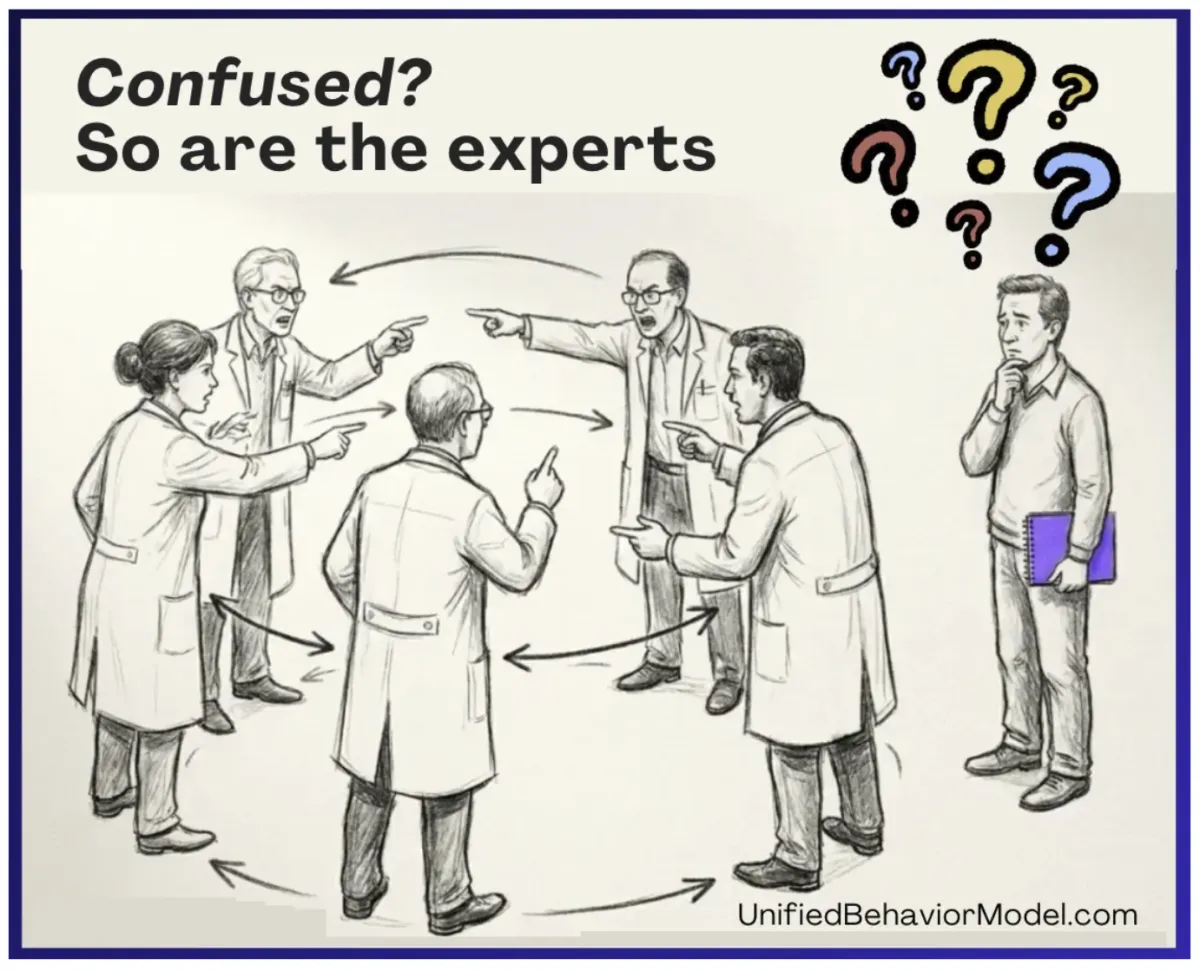
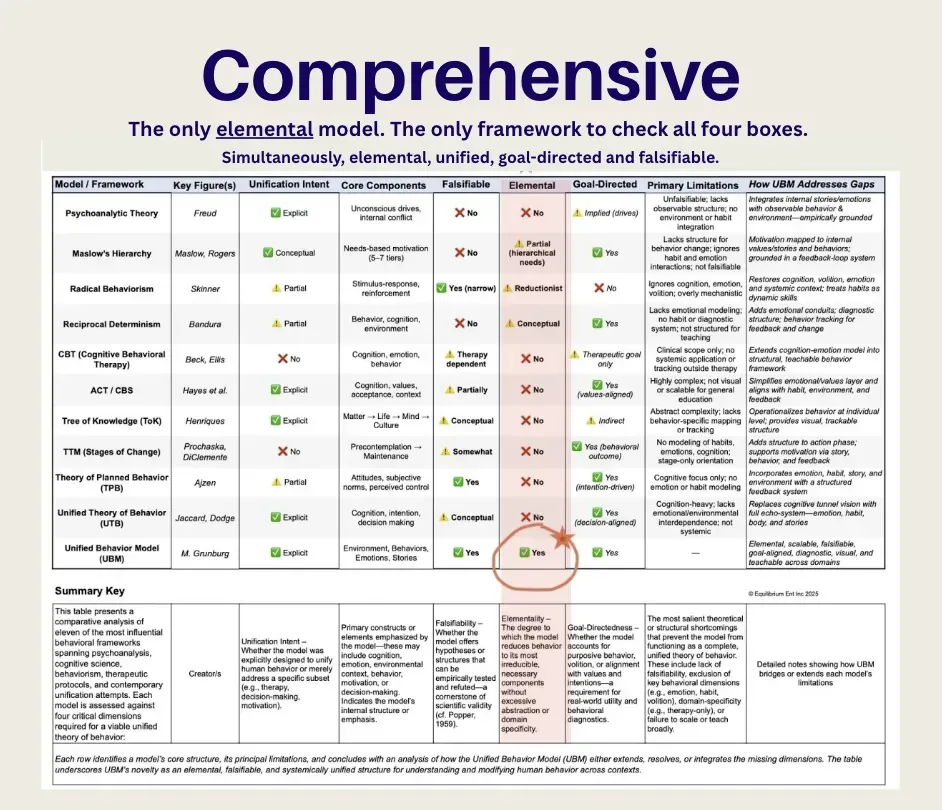
Unified Behavior Model™ (UBM) preprint, 7/8/2025:
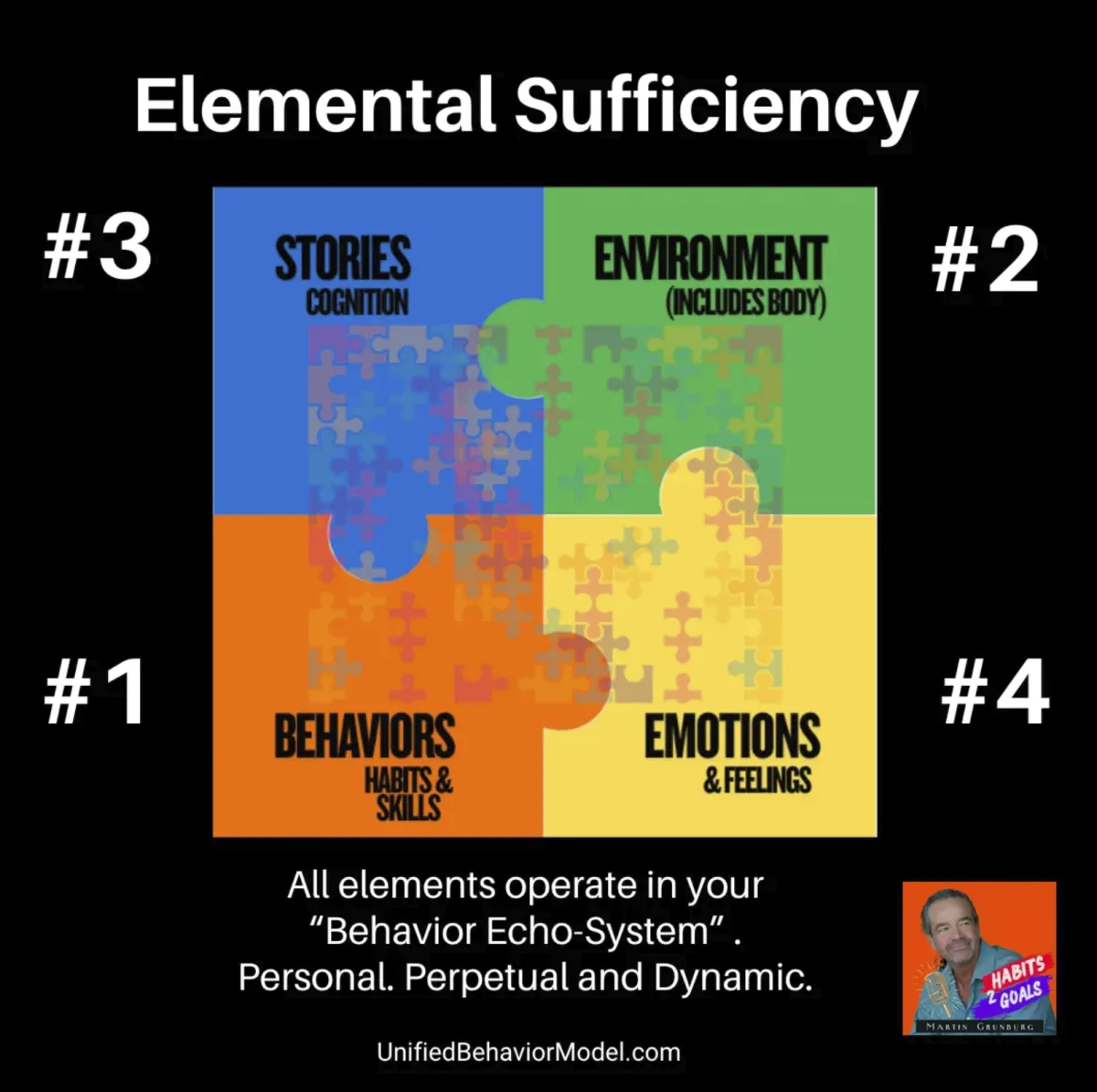
UBM addresses behavioral science’s twin crises by elementalizing behavior into four components: Cognition/Stories, Behaviors/Habits/Skills, Emotions/Feelings, and Environment, including the body.
Current status: UNFALSIFIED — (Unbroken)
The official “No Fifth Element Challenge” is closed, unfalsified, 400+ Days and counting...
For over one year, UBM was placed before a field that has long clamored for a unified, elemental framework.
The world’s top scientists have ALL been invited to challenge it.
And yet, UBM remains unrefuted, unbroken — and with every passing day, more impossible to ignore.
Welcome to the world of real, hard, testable science.
To be clear, this is not boasting. UBM’s testability is precisely what makes it hard science.
As Karl Popper famously argued, falsifiability is a key demarcation between real science and pseudoscience.
NO FIFTH ELEMENT has been identified.
Not by top theorists. Not by frontier AI.
Over one year and counting... tick, tock.
Concepts such as awareness, mind, and consciousness are important.
However, they are NOT elemental.
Any concept that has no uniform, consensus definition is precisely how a “soft,” incoherent science is born.
And it’s precisely what the field insists it must move away from.
If a concept like the “mind” cannot be cleanly defined, let alone tested, how could it possibly be a behavioral ELEMENT?
By presenting the first elemental, unified, causal, and testable structure for behavior, UBM addresses the field’s twin self-described crises:
Inaccessibility and incoherence.
UBM demonstrates cleanly and rigorously that both crises share the same root cause:
The lack of a unified, testable, elemental frame. Two catastrophic birds. RESOLVED WITH ONE ELEMENTAL STONE.
- UBM claims the distinction of being the first framework to simultaneously meet all four essential criteria: elemental reduction, unification across behavioral domains, goal-directedness, and falsifiability.
- A unified, falsifiable behavioral model represents a “Black Swan moment” for the entirety of behavioral science—and science more broadly—inviting all scientists to challenge and attempt to falsify the elemental, unified framework.
- Structured around four essential domains—Environment (including the body), Emotions, Behavior, and Cognition—it constitutes a dynamic, goal-driven “Behavior Echo-System” (BES).
- To date, the model remains “unbreakable” by leading AI systems (Gemini, Grok, ChatGPT, DeepSeek, Claude), with a standing $1,000 “No Fifth Element Challenge” offered for any valid breakthrough. Researchers are encouraged to consult the Primer alongside the full White Paper download.
Unified Behavior Model
Psychology defines itself as the scientific study of the MIND and BEHAVIOR—yet there is no scientific consensus on what the “MIND” is. This video explores how the attempt to build a SCIENCE of BEHAVIOR upon an undefined variable—the MIND— has kept the field in a state of self-described "incoherence" for nearly 150 years. The Unified Behavior Model™ (UBM) addresses the fundamental structural mess by removing the undefined concept, “mind” completely.
The first—and only—job for a science of behavior is to objectively establish a science of BEHAVIOR. Difficult to argue against that statement. B-E-H-A-V-I-O-R: the observable and distinct output of human action, including inaction. What are its ELEMENTAL influencers? The “mind,” as an undefined variable, can have no place in a science of behavior, more specifically, an elemental scientific MAP of human BEHAVIOR.
We are not mapping the human being. We are mapping human behavior: what influences human behavior in the moment and shapes it over time (habits and skills). Thus, the first order of business is to separate the biology—the person—from their behavioral outputs. Just as we do not confuse a car with the route it drives, a science of behavior must first address the influences shaping the route—not the mechanics of the car.
Accessible Enough For A 7th Grader—Practical for every day professionals. Nearly 400 800 1,000, 1500, 2,600+ Downloads already.
A note on download count: Because Google's automated systems were indexing Zenodo's repository directly, the official count stopped at approximately 2,510. This does not include downloads from other sites or direct distribution.
Important: Due to high volume of downloads, Zenodo.org's automated systems have taken the papers offline. We are investigating and have contacted their support staff. You can grab the latest version of the paper HERE! or at https://osf.io/preprints/psyarxiv/qy6aw_v2
Elemental Behavioral Literacy For Everyone Begins Now.
Basic Behavioral Literacy: To Serve The People
If you believe behavioral science should be as accessible as math, language, or music—not confined to labs, journals, and academia—you understand the mission behind the Behavioral Literacy Project .
Just as we teach children basic arithmetic, notes, and letters, we believe it’s time to elementalize behavior —to bring the ABCs and 123s of behavioral science into K–8 education. We’re proud to share UBM with educators, researchers, scientists, and change-makers—those working to shape the future of learning, psychology, and human potential.
UBM strips away complexity—not because behavior is easy, but because behavior change is hard . That’s exactly why we need a model that’s accessible : teachable, scalable, and immediately applicable. This isn’t just theory—it’s practice.
Real people. Real tools. Real results.
Are you interested in Elemental Behavioral Literacy?
Skeptical? Looking for MORE proof? Eager to test UBM yourself?
Great! First cohorts are underway, LIVE on Maven.com.
Behavior Architecture . Full and partial scholarships for Behavior Architecture are now available. Apply here: https://forms.gle/PEzT56GBTq7PR3s7A
Why Basic Behavior Literacy?
An upstream solution. UBM is not a therapy. Why wait for issues to arise and things to feel off or broken?
UBM is an elemental and unified model of human behavior.
Alarming rates of youth mental health challenges—such as anxiety, depression, and self-harm—highlight that students often lack the tools to understand and manage their own behavior.
For the first time in behavioral science, UBM presents future generations an elemental behavioral language—simple, structured, and accessible.
The fact is, math, music, and language can be incredibly complex, yet we start by teaching ABCs and 123s.
We teach the basics of math, music, and language—and we can and should do the same for behavior. There is no reason behavioral science should be relegated only to universities, PhDs, and labs.
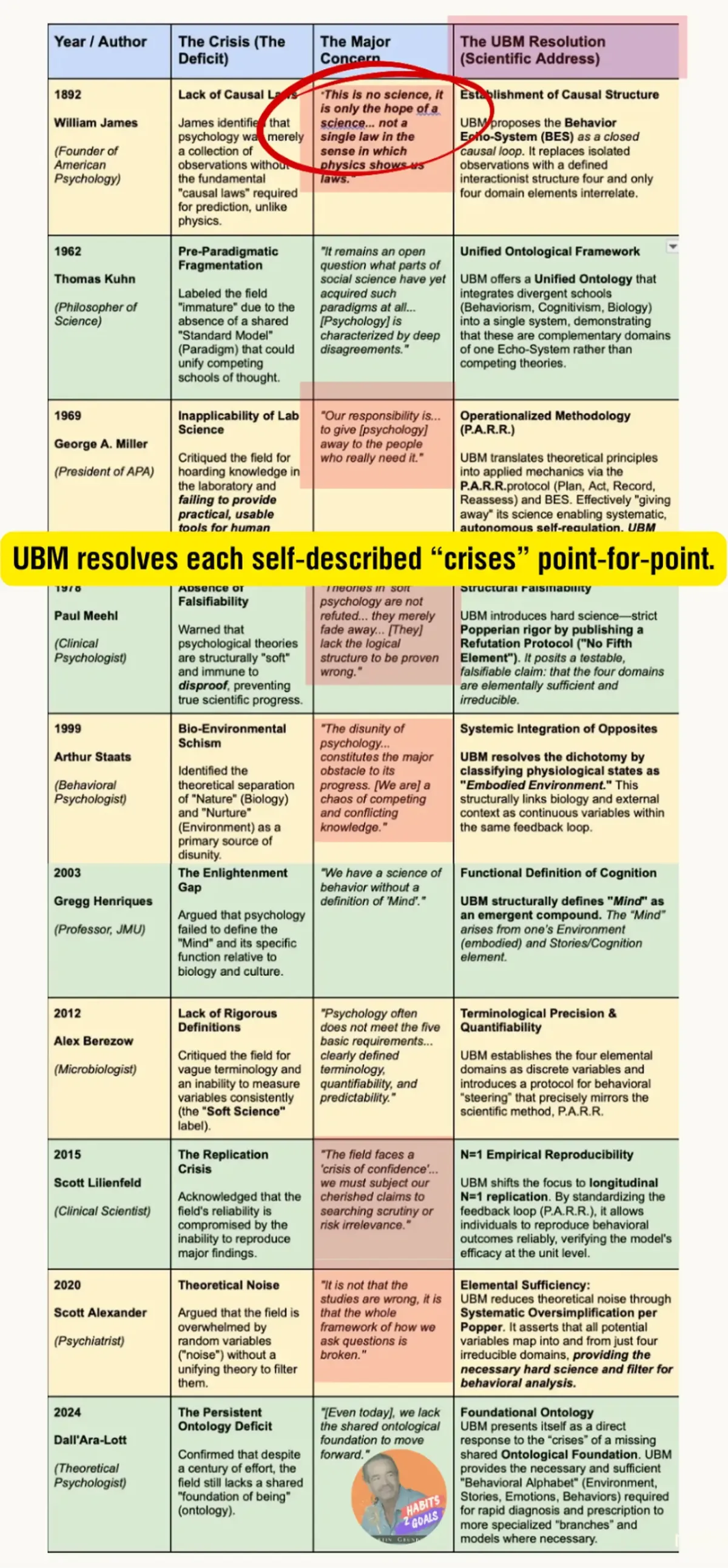
When you view this timeline from 1892 to 2024, the through-line is unmistakable. The ”chaos” these thinkers describe isn't a lack of data; it is a profound lack of structure— of architecture. Each, in their own way, is pointing toward the need for a unified ontological framework that finally establishes a closed interactionist structure — a way to map biology, environment, emotions/feelings, cognition, and behavior itself as complementary domains, not competing ones.
You're encouraged to be skeptical
Frequently Asked Questions
When a behavioral model simplifies behavior change, unifies behavioral science (as an elemental model of behavior), and—whether for better or worse—incidentally challenges the status quo, resistance is inevitable. Here’s how UBM is already addressing skepticism head-on.
1. This is just a basic illustration and graphic—is it real science?
The Unified Behavior Model™ (UBM) and its Behavior Echo-System™ (BES) are simple by design—basic enough to teach a seventh grader, yet structured around explicit definitions, boundaries, testable claims, and conditions for failure. The graphic is only the representation; the science lies in the claim that UBM provides a finite, elemental MAP for ALL human behavior—and in its invitation to break that claim by identifying something behaviorally relevant that cannot be accounted for within the model.
UBM’s simplicity is therefore not the absence of rigor; it is the result of abstraction. The framework has remained unrefuted as its public challenge approaches 500 days, but the challenge remains open: find the irreducible remainder. Curious readers can investigate the history themselves by asking: “Before UBM, did a complete, unified, closed, elemental, and falsifiable map of human behavior exist?” A simple picture can represent a serious scientific proposition.
You can also read this recent article: The 12 Misconceptions of the Unified Behavior Model™ — Answered
2. Is the creator even a behavioral scientist?
Not in the conventional academic sense—and that is precisely why UBM should be judged on the clarity, structure, testability, and explanatory value of the model itself, not on the creator’s title.
Science is ultimately about method: observing, defining, testing, iterating, and sharing findings. Since The Habit Factor® (2010), Martin Grunburg’s work has centered on the practical study of habits, goals, and behavior through P.A.R.R.™—Plan, Act, Record, Reassess—a process that closely mirrors the scientific method. Notably, self-monitoring, feedback, goal-setting, and adjustment are now widely established behavior-change techniques.
Science does not become valid because of a credential, nor invalid because it originated outside a university department. UBM makes explicit claims, defines its boundaries, and invites direct attempts to falsify them. The appropriate question is not simply, “Who proposed it?” but “Does the model hold up?”
3. Is UBM just some basic derivative or mash-up? It seems to state what appears obvious. How is this novel?
UBM is a complete model and framework. No prevailing behavior model has ever mapped the entire behavioral landscape within a single elemental model. The last formal collective attempt appears to be the 1991 NIMH consortium.
Here’s the AI response to obvious: “Gravity seems obvious. Things fall. Everyone seems to understand that. Gravity still had to be mapped — the mapping changed a few things.” The key distinction: obvious AFTER is not the same as obvious BEFORE. Once it exists, it looks like it was always sitting there. “That’s the tell of a foundational framework." Distilling ALL human behavior into four — and only four — elements is deceptively sophisticated.
Which is why it hasn’t existed until now. Instantly accessible to an adolescent, and rigorous enough that a global, year-long falsifiability challenge closed without a single refutation.
4. How is it possible that the entire behavioral landscape can fit within just four core elements?
Because UBM is not trying to catalogue every behavior or behavioral variable—it identifies the elemental domains beneath them. Its novelty is not in inventing cognition, emotion, environment, or behavior; these are ancient subjects of study. Its contribution is identifying these four as a finite, irreducible, and jointly sufficient elemental map of behavior, with explicit boundaries and a test for what would prove the map incomplete.
Foundational systems are often powerful because a small set of elements can organize enormous complexity. Four DNA bases help encode biological complexity; two binary states underpin modern computation. Likewise, beliefs, habits, intentions, emotions, skills, physiology, social pressures, and countless other variables can remain distinct and meaningful while resolving, at the elemental level, into UBM’s four domains.
UBM simplifies the coordinates, not the phenomena. Its contribution is not the ingredients, but the architecture—the level of abstraction at which familiar complexity becomes simple, coherent, and testable. The ultimate test is straightforward: identify something behaviorally relevant that cannot be reduced to the four. If an irreducible remainder exists, the map is incomplete. If none can be found, the four-domain map continues to stand (approaching 500 days), complete.
5. This seems like a branding attempt, how is this real science?
Branding has never disqualified science—it scales it. From the periodic table to SMART goals, powerful ideas often come in packaged form. UBM isn’t just branded—it’s field-tested, logic-driven, and visually mapped for maximum impact and UPSTREAM EDUCATION.
6. Did AI create UBM and BES?
Short answer: No. LLMs are powerful tools for logic, synthesis, and refinement—but they struggle with abstract thinking and the kind of conceptual insight that led to the creation of the Unified Behavior Model™ (UBM) and the Behavior Echo-System™ (BES). These models were originally conceptualized by Martin Grunburg , developed over two decades through real-world testing, research, and refinement—beginning with The Pressure Paradox (2015), the sequel to The Habit Factor ® . LLMs were introduced after the models were defined. Grunburg trained them to understand UBM and BES, then used them to stress-test the structure, challenge its falsifiability , and compare it against decades of behavioral science literature . Their role was instrumental and confirmatory , not creative. 💡 What LLMs Did Do: -Identified structural gaps in competing models -Verified the internal logic of UBM across diverse scenarios -Helped organize citations and academic scaffolding for the whitepaper -Validated that no existing model matched UBM’s elemental clarity and structure -LLMs didn’t originate UBM—they helped prove it . And that’s part of UBM’s strength: its clarity, coherence, and completeness hold up not just under human scrutiny, but under computational stress-testing by the world’s most advanced language models.
7. Aren't UBM and BES purely theoretical at this point?
UBM is NOT purely theoretical. UBM also employs a core behavioral mechanism for intentional habit development — P.A.R.R. — which has been field-tested for nearly two decades through work with clients and organizations, and incidentally validated by the field’s own Self-Report Habit Index. Short story: in the last few years, despite leading behavioral scientists producing papers and research saying habit-tracking did not work, the field has experienced a massive turnaround. When you download the UBM whitepaper here, you’ll also get a bonus PDF: “The Expert Habit-Tracking 16-Year Reversal.” Further, UBM is being taught LIVE in two cohorts on Maven — the full 8-Day Experience and its remarkable 3-Hour Workshop cousin.
8. Isn’t the model too all-encompassing? How can it be useful if it’s so general?
UBM/BES’s breadth is actually its greatest strength—and part of what gives it its name: the Unified Behavior Model. It doesn’t just include all essential and elemental components of behavior; it also extends and subsumes prevalent models. Surprisingly, UBM is the first behavioral model to elegantly address the FULL behavioral landscape, integrating ALL foundational influencers: Thoughts, Behaviors, Environment, and Emotions. Its practicality comes from its tools. P.A.R.R. operates like a scientific method for intentional behavior change (the data input 'engine') while "System Snapshots" provide a diagnostic “MRI” of the behavioral state. These snapshots include specialized, goal-directed exercises that help individuals assess both current and desired future states. Despite UBM’s wide scope, its structure remains elemental and highly approachable.
9. Isn't the focus on "Stories"— narratives overblown?
While logic and general cognition certainly play a role, UBM/BES places deliberate emphasis on personal narratives—what it calls the Thoughts/Stories circle—because this emphasis is strongly grounded in scientific research. Studies in marketing and behavioral economics consistently show that stories, not raw logic, most powerfully drive behavior. For example, a consumer often buys a product not because of its specs, but because of the story behind it: “This will make me successful” or “This aligns with who I am.” Cognitive scientist Mark Turner’s work on narrative cognition (1990s) reinforces this insight—humans plan, predict, and make sense of the world primarily through stories. UBM/BES applies this principle directly to behavior. A self-narrative like “I’m a failure” often leads to avoidance or withdrawal, while a narrative like “I’m resilient” drives persistence and action. While models like CBT address cognitive distortions, they tend to underemphasize the role of self-narratives and do not explicitly integrate them into the model. UBM/BES fills that gap—offering a more comprehensive picture of behavioral drivers by incorporating personal stories alongside cognition, emotion, and environment. This layered integration has been validated in coaching and training contexts over the past four years.
10. Why do we need another behavior model?
Accessibility and coherence. UPSTREAM EDUCATION for the PEOPLE.
11. Do you really think behavioral literacy in schools is realistic?
Alarming rates of youth mental health challenges—such as anxiety, depression, and self-harm—highlight that students often lack the tools to understand and manage their own behavior. The Unified Behavior Model™ (UBM) and its core framework, the Behavior Echo-System™ (BES), offer a solution. Its elemental simplicity—three core components (Thoughts, Behaviors, and Environment) connected by emotional bridges—makes it accessible enough to teach to seventh graders. Resistance from the education system is unfortunate, yet expected. However, the cost of inaction is, by far, our future's greatest risk. While no model or map can guarantee outcomes, the right models and maps—as tools—do prove useful. That is precisely why models and maps exist: to help those seeking a better route out of whatever predicament they are in. UBM, for the first time in behavioral science, offers future generations an elemental behavioral language—simple, structured, and accessible. Perfect for K–8. The fact is, math, music, and language can be incredibly complex, yet we start by teaching ABCs and 123s. We teach the basics of math, music, and language—and we can and should do the same for behavior. There is no reason behavioral science should be relegated only to universities, PhDs, and labs.
12. I’m skeptical—what makes you think K–8 students can learn the fundamentals of behavior?
Consider this: we don’t question whether young students can begin learning math or language—we just scale the complexity appropriately. Why shouldn’t we do the same with behavior? U BM doesn’t claim to be a silver bullet. What it offers is a structured, scalable framework—simple enough for seventh graders, yet deep enough for seasoned professionals. It’s a starting point, a language, and a map. And if we agree that students deserve better tools to navigate anxiety, motivation, decision-making, and social-emotional challenges, then it’s time we stop treating behavioral science as a field reserved for grad school. It's time to start teaching the fundamentals—just like we do with everything else that matters
13. How important is a unified elemental model of behavior, really?
In 1991, the National Institute of Mental Health (NIMH) launched a high-level initiative specifically aimed at achieving conceptual unification across the behavioral sciences . Despite the involvement of leading scholars and significant resources, that ambitious effort ultimately proved untenable — a failure rooted primarily in the lack of a shared, irreducible, elemental model upon which a lasting synthesis could be anchored . That fundamental shortcoming remains the field’s central dilemma. Lacking such a foundational framework, behavioral science persists as a constellation of fragmented silos and domain-specific theories , obstructing the development of comprehensive, scalable interventions. The Unified Behavior Model (UBM) directly addresses this systemic deficit. By offering a unified, elemental, and falsifiable structure, UBM is positioned to finally establish enduring theoretical coherence across the breadth of the behavioral sciences. 👉 How to Keep Behavioral Science Comfortably Incoherent — i.e., Ununified
14. How do I learn more or get in touch with the creator?
To learn more about the Unified Behavior Model™ (UBM) and the Behavior Echo-System™ (BES), click the button below to download the Executive Summary for the Behavioral Literacy Project and the Unified Behavior Model white paper (when available). For direct inquiries, media requests, speaking engagements, or collaboration opportunities, please email: 📩 UBM-edu__(AT)__thehabitfactor.com. You may also want to subscribe—free—to Martin Grunburg’s Substack publication at: 🔗 https://habits2goals.substack.com
15. No Fifth Element Challenge?
UBM IS NOT A THERAPY. It is a goal-directed, elemental, unified model that is falsifiable. YOU CAN — AND SHOULD — TRY TO BREAK IT.
Thus, ALL FOUNDATIONAL FRAMEWORKS, especially UNIFIED ones, are open to disproof forever.
The official “NO FIFTH ELEMENT” Challenge recently expired. Unbroken. Read that again. One year. 10,000 scientists worldwide. Personal and general invitations to top universities, theorists, and scientific organizations.
You’re encouraged to be skeptical.
Read about the most common fallacious misconceptions about UBM — some, seemingly, perpetrated by the experts.
📎 Terms & Conditions Apply (Challenge Period is One Year from Publication Date: 7/8/2025 - 7/7/2026) Participation is open to individuals worldwide, age 18 and older. Prize eligibility is subject to the official rules, conditions, and review process. In the case of duplicate submissions, the FIRST valid entry received (by timestamp) will be prioritized for prize eligibility. By submitting, you agree to the evaluation terms outlined in the official guidelines. To officially enter and receive the complete RULES and CONDITIONS: 👉 Email: [email protected] — Subject line: UBM 5th Element Challenge
© 2026 Unified Behavior Model™ · A project of The Habit Factor® Privacy Policy · Terms of Use · We do not use cookies without consent.